

“I leave Sisyphus at the foot of the mountain. One always finds one’s burden again. But Sisyphus teaches the higher fidelity that negates the gods and raises rocks. He too concludes that all is well […] The struggle itself towards the heights is enough to fill a man’s heart. One must imagine Sisyphus happy.”
Absurdist philosopher Albert Camus touched upon marvellous insight when he compared Sisyphus’ ordeal to our own lives in his seminal essay The Myth of Sisyphus, which tells the tale of an ancient king cursed to the eternal punishment of rolling a boulder up a mountain every day, for it to ultimately tumble back down. Sisyphus must nevertheless return and roll the boulder up the mountain once more, repeating the task ad nauseum 1 Camus, A. (2012). Myth of Sisyphus. New York: Random House US. .
Surely, we have all felt the absurd, yet apparent futility of going through the motions – waking up, “accomplishing” this and that, searching for something, anything to make it worthwhile. For some of us, “it” never really comes. For others, at some point it might seem to, but never really. Because eventually, the boulder always falls back down, and we are back to square one. Work, love, passion, life. All sorts of solutions are proposed, yet in truth we never really found a cure-all for existential dread and dissatisfaction with life.
This conundrum, in one form or another, has always burrowed into the minds of thinkers (and non-thinkers alike) throughout the lifespan of humanity itself; so much so that for most of us, the question has long stopped being interesting, or worth considering at all – no more than a phase one grows out of past adolescence. Eventually, many of us do seem to find happiness, or reconcile ourselves with this seemingly inescapable aspect of the human condition.
While we might agree with the notion that happiness is something one builds for themselves, I stumbled upon some literature, particularly in the field of psychology, which seem to suggest otherwise. To start with, if I might, some preliminary food for thought: Do you think most people are happy with their lives? Do you think everyone deserves to be happy? Now, do you think reality is shaped in a way that everyone can legitimately strive for their own happiness?
A history of grasping for eudaimonia
The idea of happiness, as well as how to achieve it, has obviously been a part of human thought throughout all of history. In his Nicomachean Ethics, Aristotle outlined his idea of eudaimonia: an ultimate, non-contingent form of happiness higher than any other, such as mere pleasure, honour, or intellect. For him, happiness is the thing that “we choose for its own sake, and never with a view to anything further.” 2 Aristotle, Ross, W. and Brown, L. (n.d.). The Nicomachean ethics. As such, it is inevitably framed as an end goal which all men should strive for. Aristotle also viewed reason as the main instrument with which we will achieve true happiness. A similar rationale can be found in Stoicism, an influential discipline which perseveres to this day. The Stoics would argue that a good, happy life is associated with being virtuous and rational, as well as cultivating an attitude of calm and indifference towards external events 3 Inwood, B. (2009). The Cambridge companion to the Stoics. Cambridge: Cambridge Univ. Press. .
These classical Greek views crept into a major part of the Judeo-Christian values which dominated Western civilization thereafter 4 Daniel W. Graham and James L. Siebach, “Philosophy and Early Christianity,” 210-220. . If we were to include Islam as a descendant of this moral tradition, we can safely say that a majority of current modern citizens believe that virtuous, righteous behaviour will lead them to the path of a happy life. The end goal may be heaven, or the blessing of God; in any case, we surely believe that upon reaching these end-points, we will be happy forever after.
Consequently, these teachings promote the dogma that happiness is something we can surely grasp, if only we put in the energy and determination to live life to the fullest. It manifests itself in society urging us to work hard, do great things, set goals and achieve them, and so on. All of this with the implicit promise that if only you tried, true happiness will be yours.
Evidently, these messages did not bode well with everyone; much less philosophers. In fact, Camus was not the first who came up with the concept of the “absurd world” where we try to find meaning and happiness, yet the universe does not seem to present any. In the words of 19th century Danish philosopher Soren Kierkegaard, “Ordinarily, most people aim their ideals at the Great, the Extraordinary, which they never attain. I am far too melancholy to harbour such ideals.” 5 Kierkegaard, S. (2000). The Diary of Soren Kierkegaard. Citadel Press. Nevertheless, Kierkegaard still proposed a solution: A “leap of faith”, as he put it, wherein in the face of existential dread, one must power through by the virtue of pure faith (he was a devout Christian) 6 Kierkegaard, S., Lowrie, W. and Campbell, J. (2019). Concluding Unscientific Postscript. Princeton: Princeton University Press. .
Other, more pessimistic views continued to emerge throughout the 19th– to 20th century from Nietzsche, Schopenhauer, to Cioran and countless others, ironically as civilization seemed only to continue progressing and developing and as living standards across the world continued to improve. It would be foolish to attempt to dissect all this discourse in one article. In very short terms, it can be said that a considerable part of humanity was struggling with accepting the notion that one only needs the “will” to be happy, and to find meaning; as we should know, many of us never seem to find it.
The hedonic treadmill: blessing or curse?
It seems to be a common consensus that we are all universally yet uniquely aware of the “human condition”; paradoxically, we might also wield the extended assumption that none of us would ever understand or comprehend it in any objective manner. To this, if I may object; on the other end of the spectrum of knowledge, those tinkerers and experimentalists in the inductive field of science have built upon a rigorous body of knowledge regarding the human brain. Perhaps, our understanding of the human condition is not as obscure as we might think.
Brickman and Campbell first wrote about the idea of “hedonic adaptation” 7 Brickman; Campbell (1971). Hedonic relativism and planning the good society. New York: Academic Press. pp. 287–302. in M. H. Apley, ed., Adaptation Level Theory: A Symposium, New York: Academic Press , which later became more widely known as the hedonic treadmill. The theory conjectures that each person has a certain “hedonic set point”, a default level of happiness, to which one will tend to return despite short-term periods of happiness or sadness. In her book The How of Happiness, Sonja Lyubomirsky finds that around 50% of one’s happiness is derived from this hedonic set point, while 40% comes from present actions, thoughts and attitudes and the final 10% is determined by external circumstances 8 Lyubomirsky, S. (2007). The “How” of Happiness. Penguin Press HC. . It is not hard to relate to this idea; we might graduate from university, or get a job, or land a promotion, after which we will be happy. After a while, though, we will get used to the new condition and return to our default state of happiness. On the flipside, we might get rejected from our dream jobs, or fail an exam, or break up with a partner, but eventually, things would get better, and we will return to our former selves.
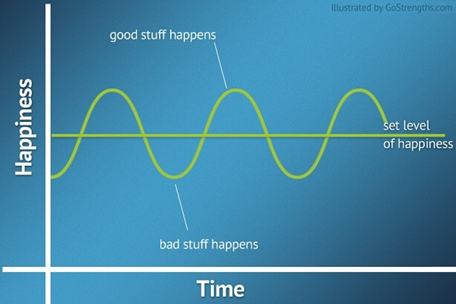
(Illustration by GoStrengths.com)
Eventually more research continued to support this notion. One paper studied lottery winners and paralysis victims; respectively the lottery winners experienced initial spikes of happiness, and the paralysis victims appeared devastated by their misfortune. In the long-term, however, neither group appeared to be happier than the other 9 Brickman, P., Coates, D. and Janoff-Bulman, R. (1978). Lottery winners and accident victims: Is happiness relative?. Journal of Personality and Social Psychology, 36(8), pp.917-927. . Another study researched the long-term happiness levels of accident victims who had sustained severe spinal cord injuries; by eight weeks after the accident, the subjects had mostly recovered to their pre-accident happiness levels 10 Silver (1982). Coping with an undesirable life event: A study of early reactions to physical disability. Unpublished doctoral dissertation, Northwestern University. OCLC 25949964 .
These findings might appear uplifting, and perhaps it is; it shows that our happiness is incredibly resilient and elastic. We can recover even from life-changing traumatic events. It would seem that eventually, things do get better. However, before we celebrate the marvel of the human mind, we must also consider that the hedonic set points of each person are not necessarily the same, or even similar. Now, how much variability is there?
A monumental study by Lykken and Tellegen tries to answer this very question, and instead arrives at an even deeper conclusion 11 Lykken, D. and Tellegen, A. (1996). Happiness Is a Stochastic Phenomenon. Psychological Science, 7(3), pp.186-189. . They conducted a study on several thousand subjects, over a timespan of 10 years. Their findings? Firstly, in their own words, “Neither socioeconomic status, educational attainment, family income, marital status, nor religious commitment could account for more than 3% of the variance in WB (Well-Being, the study’s measure of happiness).” Secondly, “From 44% to 52% of the variance in WB, however, is associated with genetic variation”. Lastly, “[…] we estimate that the heritability of the stable component of subjective well-being approaches 80%”.
Now, the hedonic treadmill might begin to seem more menacing. What might be a trampoline of sorts, to launch us back up when we are down, is also an anchor, weighing us down when we try to rise higher. The study accounted for pretty much everything one could think of life as being about – social status, education, income, marriage, and religion – none of these factors impacts our happiness as significantly as genetic variation (not even close). It should be deeply unsettling, to us as a society which proposes the self-determination of happiness based on freedom and will, to think that all this time it was mostly an inherited trait (and with very high heritability!).
You might wonder, what do the distributions look like? Well, for one, here are the happiness levels based on socioeconomic status, with 1 symbolizing the professional class (top-tier), 6 for unskilled labor and 7 for the unemployed. As you can see, there is hardly any difference in the level of happiness between the very top and bottom of society. In fact, the laborers tend to be ever so slightly less happy than the unemployed:
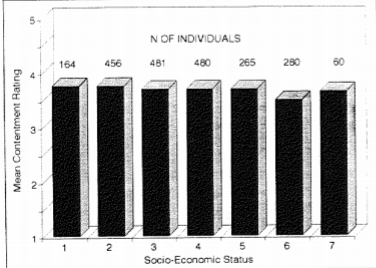
(Source: Lykken and Tellegen, 1996)
We might think that intuitively, we have anticipated, or even known, this aspect of human nature. We might think, we know that, after all is said and done, status, money, or love will not make us live “happily ever after”. But then, riddle me this: Why do we continue to pursue them? Why, if not for a glimpse, even a sliver of hope, that it actually will bring us blissful happiness? Happiness is, after all, the end goal of all end goals. It is the final purpose of which everything else is merely a medium. Alas, what empirical research we have only shows that all of it is most likely futile.
It should be clearer now to see what Camus was getting at with the story of Sisyphus; if the rock symbolized our happiness, we are Sisyphus pushing the rock up the mountain, only for it to fall back down in the end, forever repeating the drill. We can never hold the rock at the top of the hill forever.
But it gets darker…
At this point one might think that this is still not such a bad deal. Besides, consider the previous graph; the average level of contentment for all social classes hovers around 3.5 out of 5; similar numbers arise for income, marriage, and religiosity. Surely, would this not mean that we are all more often happy than not? Now, if you have the stomach for it, let me take you even deeper down this rabbit hole.
Firstly, consider this chart of the overall distribution of average contentment ratings from the same study:
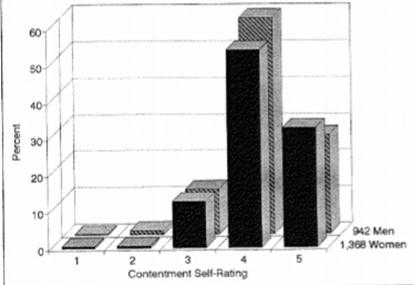
(Source: Lykken and Tellegen, 1996)
As expected, a clear majority of roughly 50% hover at a 4/5 contentment rating. However, there are a few caveats. Firstly, the basis of this measurement is purely self-reporting: The subject is regularly asked the question: “Taking the good with the bad, how happy and content are you on average compared with other people?” Evidently there is a potential bias in the self-assessment; the math simply does not add up if 86% of the subjects are actually in the top 35% of overall contentment. As such, there is an inherent tendency for one to consider themselves “happier than other people” purely on the merit that they can easily imagine people with situations graver than them, as we are biased to the negative scenarios and examples 12 Baumeister, Roy F.; Finkenauer, Catrin; Vohs, Kathleen D. (2001). “Bad is stronger than good” (PDF). Review of General Psychology. 5 (4): 323–370. doi:10.1037/1089-2680.5.4.323 .
Secondly, consider that even with this bias, some 1-2% of people rate themselves at levels of 1 to 2 out of 5. Now remember: these happiness levels have tended to be highly consistent over the research period of 10 years. Thus, these 1-2% of people have considered themselves significantly less happy than other people over this entire period. To this, add the clear finding that this hedonic set point is mostly determined purely by genetic heritage, and we arrive at the darkest side of the hedonic treadmill: these people might be sad for their entire lives, and there is likely nothing they can do.
Another piece of research seems to support this grave outcome: A 2011 paper studied how people respond to major life events such as bereavement (losing a spouse to death), marriage, and divorce 13 Mancini, Anthony D.; Bonanno, George A.; Clark, Andrew E. (2011). “Stepping Off the Hedonic Treadmill”. Journal of Individual Differences. 32 (3): 144–152. doi:10.1027/1614-0001/a000047 . The results are mapped into three to four distinct pathways which the subjects seem to follow quite predictably, with a majority (70-80%) showing high resilience. For instance, here are the results for bereavement:
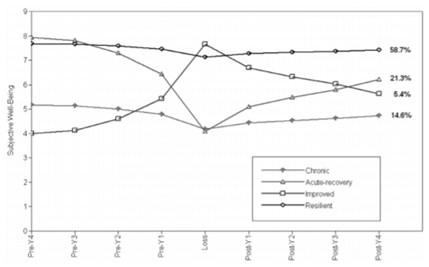
(Source: Mancini et al., 2011)
As per the previous study, a wide majority of subjects (58.7% for the “Resilient” pathway and 21.3% for the “Acute-recovery” pathway) started off with high (8/10) levels of SWB (Subjective Well-Being, the study’s measure of happiness). Meanwhile the rest start off relatively lower at 4-5 out of 10. Alas, most people retain their original levels of happiness 4 years before- and after the event; 21% experience severe sadness but bounce back in the years to follow, while 14.8% (the “Chronic” pathway) start sad and remain sad (the “Improved” pathway, if I may conjecture, likely consists of subjects unsatisfied with their marriages, which could explain the sudden spike in happiness during the event).
Similar results can be observed for the cases of divorce (top) and marriage (bottom):
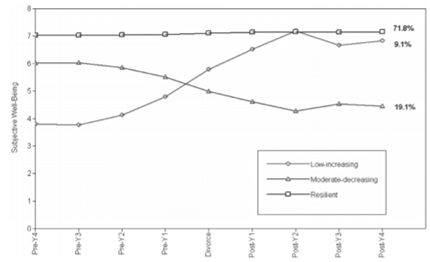
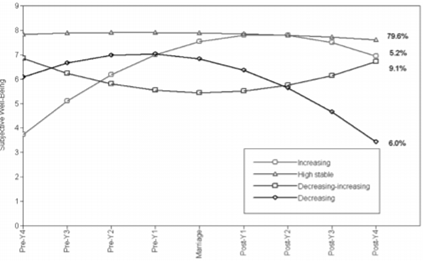
(Source: Mancini et al., 2011)
All in all, short term happiness may vary (while the majority are predictably resilient); but in the end, those who start happy will return so, and those who start unhappy will return so as well. Another research by Bottan and Troglia supported the inertial nature of happiness; if you have a high value of happiness in the past, it’s more likely you will be happy in the present, vice versa 14 Bottan, N. and Perez Truglia, R. (2011). Deconstructing the hedonic treadmill: Is happiness autoregressive?. The Journal of Socio-Economics, 40(3), pp.224-236. . In the 1996 study, Lykken and Tellegen concludes with remarks questioning our knowledge of how happiness truly works: “[It is] suggested that people who enjoy close relationships, who become absorbed in their work, and who set themselves achievable goals and move toward them with determination are happier on the whole than people who do not. We agree, but we question the direction of the causal arrow.”
Perhaps in reality, it is because certain people have a certain genetic predisposition to be happy that they would do such things; perhaps this is why for quite some of us, doing these things might seem so ineffectual, and so futile in the face of a genetically-predisposed low hedonic set point.
The abandoned minority
These ponderings may be grim, yet they paint a highly vivid picture of the human condition that we might find difficult to articulate; so predictable, yet so diverse, they paint a beautiful picture of humanity as a race, struggling to cope with the “Absurd”. Perhaps this is why for many of us, it feels so difficult to relate to people suffering from depression, or prolonged periods of darkness. Else, how could one be so downtrodden for so long? Are they not grateful enough with what they are given? Why can’t they just get better, and deal with it, like everyone else? Perhaps now, we can see clearer. It should help us become more empathetic to realize that the human condition is in no way universal, nor uniform; that for some of us, life might as well be hell. To quote the great pessimist Arthur Schopenhauer’s masterpiece, The World as Will and Representation:
“There is only one inborn error, and that is the notion that we exist in order to be happy […] So long as we persist in this inborn error […] the world seems to us full of contradictions. For at every step, in things great and small, we are bound to experience that the world and life are certainly not arranged for the purpose of maintaining a happy existence…” 15 Schopenhauer, A. (2012). The world as will and representation (the world as will and idea). [Stilwell, Kan.]: Digireads.com Pub.
Surely, Schopenhauer’s words will not resonate with all; but for some, it is a confirmation that they are not alone. It is a monument to the sheer range of the wide spectrum with which humans can experience life, and some of us are in the far end of that spectrum.
So… what then, for this abandoned minority, unrelatable and alienated by society? Is there any way out? Perhaps not. But, while many of us should easily grasp Camus’ musing that “one must imagine Sisyphus happy” (as they are happy by default), I find that so too can this apply for the rest of us – one must only look deeper.
In the dark corners of the internet, the depressed, the lonely, the hopeless, the bitter have formed fringe communities. In general, people are, after all, social creatures – no matter how crestfallen. Deep in these virtual recesses, a movement has risen by the name of “doomerism” – out of comical characters and internet memes, droves of cynics, rejected by society, seek to express themselves:

(Source: knowyourmeme.com)
By taking the form of an internet meme, the movement has sparked a considerable online following and continues to thrive on the shadowy crevices of the world-wide web. This is perhaps consoling in a sense; rejected by society, these outcasts have found a welcoming oasis. What is truly fascinating, however, is how the movement has come to evolve over time – showing at times what would seem to us as purely hideous bitterness in the form of the racist, white-supremacist alt-right 16 Southern Poverty Law Center. (2018). McInnes, Molyneux, and 4chan: Investigating pathways to the alt-right. [online] Available at: https://www.splcenter.org/20180419/mcinnes-molyneux-and-4chan-investigating-pathways-alt-right [Accessed 19 Feb. 2020]. , or the sexist “incel” (involuntary celibate) movements 17 Beran, D. (2018). Who Are the ‘Incels’ of 4chan, and Why Are They So Angry?. [online] Pacific Standard. Available at: https://psmag.com/news/who-are-the-incels-of-4chan-and-why-are-they-so-angry [Accessed 19 Feb. 2020]. . Truly humanity at its lowest – or rather, I daresay, these manifestations serve clearly as anguished screams by the powerless and voiceless, desperate to leave their mark in what they can only see as an ugly, cruel world.
Yet, despite all this gloom, a more hopeful glimmer of light has surfaced more recently – a plea to face the darkness not with violence, but rather a more profound approach:

(Source: knowyourmeme.com)
This evolved form of the doomer shows an attempt to overcome the bitterness, but not exactly with positivity or hope (as we have established, this is not so feasible), but with a refined form of resistance. The doomer above is evidently not happy, no – he is defiant. He knows that he has never been happy as most other people are and perhaps he never will be; yet he forgoes suicide and letting go instead choosing to act purely as a token of his sheer will.
Happiness is nothingness
This, after all, is what Camus really meant to teach us through Sisyphus: the idea of the “Absurd Hero”, who struggles perpetually, and most importantly, without the hope of success. For after all, the only alternative is death; and Camus himself famously said, “There is only one really serious philosophical question […] and that is suicide.” Consider for a moment, what does it really mean to be “happy forever after”? If one were happy forever, without any moment of sadness, would it really be happiness at all? We are all in pursuit of as much happiness as we can muster, yet, if we ever got there, then what? The same question would apply for heaven, or nirvana, or eudaimonia.
Perhaps the believers would say, the question itself is paradoxical; if you ever got there, you would not need to ask. In this case, if I dare say, we might deduce that “getting there” equates only to being nothing; desiring nothing, feeling nothing. If true happiness can be represented as a constant and sustained peak of our hedonic set point, with hedonic adaptation never kicking in, then truly, we would be at the point the religious might call “released from pain and suffering and mortality into the peace of everlasting life” 18 The Book of Common Prayer. (2004). Dublin: Columba Press by authority of the General Synod of the Church of Ireland. . One might then ponder: would that be any different than not being at all? Even those who actively try to desire nothing (per the Buddhists), or to be supremely indifferent to the happenings of the universe (per the Stoics); are they sure they should not simply die instead? Then we should ask: if true, pure happiness requires no more than being nothing, then why would we ever choose to live? Even those who actively strive to feel nothing and, emotionally, be nothing will face unending struggle in order to achieve perfect indifference. Then we should ask: if true, pure happiness requires no more than being nothing, then why would we ever choose to live?
Perhaps, we never really wanted to get there after all.
“But I don’t want comfort. I want God, I want poetry, I want real danger, I want freedom, I want goodness.
I want sin.”
Aldous Huxley, Brave New World19 Huxley, A. (1932). Brave New World. London: Chatto & Windus.
Finally, a disclaimer
The idea for this article came to me, roughly two months ago, in the form of haphazard and disorganized thoughts, and perhaps they remain so. I knew there was something I wanted to say; it took much longer to figure out what it really was.
I have come to realize that what I really wanted to say involves not only the philosophical and scientific discourse regarding the “human condition” nor the hedonic treadmill, but rather something much more personal; it has perhaps become a journal, tracing my unadulterated thoughts regarding this (obviously) immensely difficult problem. As such, I would advise the reader to take this article with a heavy grain of salt.If I may be completely frank, nobody really knows how any of this works.
Editor : Rama Vandika Daniswara, Muhammad Daffa Nurfauzan
Illustrator : Fanindya
Referensi

Discussion about this post