

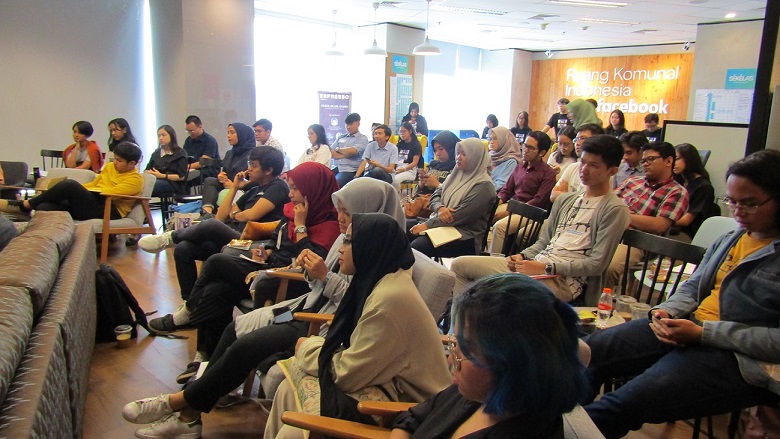
We use the term ‘beautiful’ very broadly; when describing art, when describing something joyous, when describing our significant others—all in all beauty is a word of such abstract concept that it may fit anywhere we deem so, but always related to that of positive expressions. How can something so abstract then found a benchmark to nest itself upon which features on a person are considered beautiful? Moreover, how can something related to that of positive expressions cause damaging social bias 1Kim, S., & Lee, Y. (2018). Why do women want to be beautiful? A qualitative study proposing a new “human beauty values” concept. PLoS ONE, 13(8), 1–25. https://doi.org/10.1371/journal.pone.0201347 especially with the perceived absence thereof? Badan Otonom Economica tried to stimulate answers to those questions through the 5th ESPRESSO, an annual public discussion held last Saturday (16/11), with this year’s grand theme of “Glitz, Glam, Gloss: The Anatomy of Modern Beauty”.

Introduction to Beauty Ideal
When talking about beauty, we’re not only talking about an abstract concept but also biological perception. Faisal Aslim, a clinical psychologist and one of the panellists, explained how beauty standard is essentially a result of our evolutionary process, in which we seek certain features in our partners to support the sustainability of our future offspring (e.g: wide hips on women to bear children, and strong build on men to protect his kin). Such is also an elaborate argument written by Harari in his bestseller, Sapiens, where he said that our perception of beauty is greatly influenced by our need to survive and sustain 2Harari, Y. N. (2011). Sapiens: A Brief History of Humankind (1st ed.). Israel: Harper.. With such framework, beauty standard tends to be more constant than dynamic, because every human is hardwired with the same instinct on survival 3 Nicholson, N. (1998). How Hardwired Is Human Behavior? Harvard Business Review, July-August 1998 Issue. Retrieved from https://hbr.org/1998/07/how-hardwired-is-human-behavior to pass the environmental selection and, with regards to physical standards, sexual selection 4 Papathomas, A., Smith, B., Lavallee, D., Anderson, C., Kirkpatrick, S., Bodenheimer T, Lorig K, H. H. & G. K., … Shaw, W. S. (2016). Sexual selection. History Workshop Journal, 80(3), 302. https://doi.org/10.1007/s11065-015-9294-9.Functional.
In contrary, Khaerul Umam Noer, another panellist who is the head of Centre of Women and Gender Studies Universitas Indonesia, narrated how beauty standard has changed throughout the years through the influence of media. He brought up the example on how Indonesian medias showed two different depictions on ‘ideal women’ as portrayed in the movie Si Doel, taking form in Zaenab and Sarah; one is collected and submissive, favoured by the society in return, while the latter is outspoken and rather brazen, still beautiful physically but not so attractive as the ideal partner. Beauty according to him is more than just a sexual mating requirement, but also a matter of behaviour which in its turn create a good set of ideal.
If you ever watched Buzzfeed’s videos on beauty standards, you will then most likely agree that beauty standard is unlike many other standards in which it is subjectively and fluidly progressive—shown by the way it could adapt to various cultural propriety 5BuzzFeedVideo. (n.d.). Men’s Standards Of Beauty Around The World. Retrieved from YouTube website: https://www.youtube.com/watch?v=tneKwarw1Yk and time-related trends 6 As/Is. (n.d.). Beauty Standards Around The World. Retrieved from YouTube website: https://www.youtube.com/watch?v=RT9FmDBrewA . The normative standard (i.e: small waist, slim body, fair skin, straight nose, etc) is no longer the prevailing standard, instead, today we celebrate an inclusive kind of beauty 7BuzzFeedVideos. (2015). Women’s Ideal Body Types Throughout History. Retrieved from YouTube website: https://www.youtube.com/watch?v=Xrp0zJZu0a4&t=1s where it matters not the colour of your skin, nor the size of your clothes—everyone is beautiful the way they are. Gone are the days of bleaching our skin dry, and starving ourselves into two pounds less on the scales.
Why must beauty be progressive?
The problem which comes with beauty standard is the existence of discrepancy between the pictures on the magazine—which are supposedly the ‘ideal’ version of a human physique—and the person you see in the mirror, because 99.9 percent of the pictures portrayed in medias are said by Blake Lively to have gone through digital alterations be it minor or major 8 Matthews, I. (2019). Inclusive Beauty Trend Drives Makeup Sales. Retrieved from https://www.happi.com/issues/2019-11-01/view_eurotrends/inclusive-beauty-trend-drives-makeup-sales/, taking them further away from reality. Lively herself felt such digital alterations are a ‘relief’ to some of the otherwise terrible elements in her photoshoot. This kind of ideal comparison 9 Betz, D. E., Sabik, N. J., & Ramsey, L. R. (2019). Ideal comparisons: Body ideals harm women’s body image through social comparison. Body Image. https://doi.org/10.1016/j.bodyim.2019.03.004 is dangerous, undoubtedly, and what more is that there might also be a disparity of perception between your own and other’s opinion on your appearance. Lifni Sanders, the next in our line-up of panellists who is a beauty vlogger and body-positive activist, explained that such disparity will unavoidably cause a problem which will lead into severe mental health issues such as social anxiety and depression. The problem does not stop there, as it also manifests into eating disorder caused by the glorified ‘thin ideal’ shown by several fashion companies and advertisements 10Bessenoff, G. R. (2006). Can the media affect us? Social comparison, self-discrepancy, and the thin ideal. Psychology of Women Quarterly. https://doi.org/10.1111/j.1471-6402.2006.00292.x.
Another problem with the normative standard is that it creates a social class of some sort; allowing beauty to carry with it some kind of ‘premium’ that ease individuals which fall on and or above the standard to mobilise within the society. The existence of an inclusive standard can minimise those risks in a way that when there is no more ideal or benchmark within the concept of ‘beauty’, there will be no more phenomenon of ‘constant self-surveillance and disciplinary practices’ (Grogan, 2016).
When talking about beauty standard, we will unavoidably also talk about the beauty industry—in which one cannot stand without the other. Within that condition, when one of the two becomes inclusive, the other one will follow; in this instance we can see the beauty industry responding to demands of inclusivity. One case in example is Fenty Beauty’s 50-shades foundation (40 during its release on September 2017), ranging from the darkest to the palest of shade, accommodating all skin colours including those in-between. People celebrated this progressivity, seen from the fact that Fenty was named as Time Magazine’s “Best Invention of 2017” 11Bruner, R. (2018). Blake Lively Says “99.9%” of Celebrity Images Are Photoshopped While Interviewing Gigi Hadid. Retrieved from https://time.com/5236384/blake-lively-photoshop-gigi-hadid-interview/ and the way it scored a place amongst Time’s “Top 50 Most Genius Companies of 2018”. According to Lifni, this progress is vital for her Papuan sisters and similarly darker-skinned people who had difficulties finding the right shade for them, whereas she has never really been impacted by the colourism found in the beauty industry, as she has a relatively light skin colour.
Why makeup?
Makeup essentially exists as a camouflage or a tool of seduction 12Korichi, R., Pelle-De-Queral, D., Gazano, G., & Aubert, A. (2008). Why women use makeup: Implication of psychological traits in makeup functions. Journal of Cosmetic Science, 59(2), 127–137.. As a camouflage, it serves a way to balance out the ‘beauty premium’, according to Lifni. She explained how makeup exists as a way to enable people who are disadvantaged by the absence of perceived beauty in themselves to catch up with the existing standard, which is why a foundation for every skin colour and skin type is important—not just foundation, but all makeup in general. In other words, or in the words of Korichi, really, “women with a negative feeling about their image develop defensive mechanisms to cope with low self-esteem and may need to ‘normalize’ or manipulate a perceived impaired appearance” (Korichi et al, 2007).
Umam then argued that the existence of such broad-ranging makeup for all skin tones does not feel like a liberation at all—instead it cages us in the same, only broader, standard. “We have no more reason to be ugly nowadays,” he joked, “we can all be pretty with the right shade of foundation and concealer”. It still carries the narrative that to feel secure, to be perceived as beautiful, you need to cover up your blemishes; how is this liberation? He tried to, indirectly, criticised people for campaigning against beauty standard by still campaigning for it—if you’re ready to go against the standard, why do you still need to spend time figuring out which shade fits you best? And when you cannot find your shade, why not settle for your bare face and natural skin tone?
Two responses came from Lifni in which she said that it’s not a matter of not being able to settle with bare face and natural skin tone, but it’s a matter of not wanting to settle with the existing shades, as a result of years of discrimination due to your skin colour. To use or not to use makeup is a choice, but the problem was the absence of choice when it came to darker-skinned consumers; it’s as if emphasizing that only lighter-skinned people are allowed a choice to choose whether to be beautiful with or without makeup, but darker-skinned people didn’t even have that choice to begin with. So what people celebrate with the existence of Fenty’s various shades is not merely the shades, but the inclusivity that it brings; the way it tries to poke at the standard of colourism in the beauty industry makes Fenty Beauty a real hero, creating what is now known as the Fenty Effect 13Bach, N. (2017). Rihanna’s New Fenty Beauty Line at Sephora Expands Her Business Empire. Retrieved November 24, 2019, from Fortune Most Powerful Women website: https://fortune.com/2017/09/08/rihanna-makeup-fenty-beauty-launch/ in which other brands also try to catch up with the inclusivity that Fenty first promoted.
The second issue is the use of makeup itself; other than as a camouflage, makeup also serves a seduction function, in which people wear it not to fake confidence but simply to find pleasure in themselves 14Korichi, R., Pelle-De-Queral, D., Gazano, G., & Aubert, A. (2008). Why women use makeup: Implication of psychological traits in makeup functions. Journal of Cosmetic Science, 59(2), 127–137. . It’s almost like dressing yourself; you prefer to wear clothes you like because it serves a satisfaction of aesthetic. There are various reasons to wear makeup, yes, and there were two different arguments that stood until the end of the discussion in which Faisal and Lifni agreed that makeup can serve as an expression of confidence, either worn or not, while Umam argued that if you need any sort of covering for your blemishes, that is not real confidence, and by doing so you’re not doing anything to better the prevailing standard.
Self-Love vs Self Indulgence
Talking about confidence, Faisal also claimed that the depression caused by disparity of ideal and reality depends on our choice whether to be triggered or not by the society’s perception of our appearance; meaning that we have a say whether we want to kneel before the standard or stand tall still with our supposed ‘blemishes’. Such is essentially the fundamental argument of the self-love movement we know today. The self-love movement is another attempt from the society to poke at the unrealistic ideal, where it basically tries to stop people from comparing themselves to the supposed ‘ideal’, and increase someone’s satisfaction on themselves.
One of the participants of the discussion came up with an opinion that self-love essentially is a toxic coping mechanism to help us deal with rejection from society and holds no apparent changes other than artificial acceptance of oneself. She explained that the disparity we talked about in the beginning of the discussion will still happen even with the existence of self-love, because there are two different practitioners of self-love according to her: the normatively beautiful people, and the ones who don’t fulfil the standard, or as she said it the ‘disfigured’ ones. When the normatively beautiful or at the very least attractively acceptable ones practice self-love, there is a congruency between what they tell themselves and the way people treat them—or in other words, your inner perception of your own appearance is in line with other people’s perception of your appearance, seen from the way they treat you. But when the said ‘disfigured’ ones try to apply self-love, such congruency won’t be found, because there will always be some grade-A jackass bullying them for the way they look.
This condition, then, is no different from lying to yourself, as in when people treat you badly but you cower behind the notion of ‘self-love’, branding yourself as okay. In the end this may also lead into another roundabout case of mental illness. To this Faisal answered that our own rejection of many things is the grassroot of mental illness. We put a standard for ourselves by seeing the benchmark in the society, yes, but at the end of the day, it’s still our standard and we do have a say on which set of standard we’d like to reject and to what extent. Moreover, it helps to have a positive affirmation of self-acceptance, because without the existence of self-acceptance, people would always feel the need to further beautify themselves (Bergman in Weusten, 2009).
Another problem with the notion of self-love today is that it is often mistreated as self-indulgence, which are two different things altogether. Self-love, according to Andrea Gunawan, is treating yourself with kindness and taking the time to take care of yourself, whereas self-indulgence is doing something without being mindful of your well-being. Andrea, in her video with the Kindred Spirits channel 15 KindredSpirits. (2019). The Meaning of Self-Love | Kindred Spirits | KS CHATS. Retrieved from YouTube website: https://www.youtube.com/watch?v=N3yZgLtXcxs&t=808s, brought up the example of people getting spa treatments as a form of self-love as opposed to finishing a tub of ice cream (in one sitting) for personal pleasure, which is an act of self-indulgence.
#EffYourBeautyStandards
The discussion about self-love vs self-indulgence then led us into another form of the progressively inclusive beauty. An American model, Tess Holliday, made popular the hashtag #EffYourBeautyStandards with the purpose of encouraging plus-sized people to express themselves and not be afraid of judgements from the society. The result of this campaign is more and more curvy, overweight, and even obese people—mainly women and girls—posting pictures of themselves in all their ‘plus-sized’ glory. It was a beautiful celebration of self-acceptance, yes, it was also another attempt to poke at the restrictive ‘thin ideal’ set by many fashion companies as aforementioned. It gave confidence to people who are not as skinny as size 2, but also encouragement for people who are of size 0 that it matters not the numbers on your scales—because with the rise of the ‘curvy ideal’, suddenly thigh gap is not something terribly sought-after.

The problem that came with #EffYourBeautyStandards is the message that Holliday herself brings: that obesity is something to be celebrated as well. Piers Morgan slammed her in an open letter for portraying an image that it’s perfectly fine to be obese and not do anything about it 16Morgan, P. (2018). An open letter from Piers Morgan to Tess Holliday: Stop lying to yourself Tess – you’re morbidly obese and it’s going to kill you. Retrieved from MAILONLINE website: https://www.dailymail.co.uk/news/article-6190487/PIERS-MORGAN-Stop-lying-Tess-youre-morbidly-obese-going-kill-you.html. Holliday weighs 127 kg at 165 cm of height, which means she has a BMI of 38-40, classifying her as morbidly obese. With such proportion, Morgan argued, she is only getting the cover of Cosmo and endless TV appearances because she’s “massively, dangerously overweight yet feigning joy.” A YouTuber, Lauren Chen, even went as far as saying that the only way for Holliday to stay in the limelight is by being morbidly obese and proud about it 17Chen, L. (n.d.). Body Positivity Model PHOTOSHOPS Herself | Tess Holliday Hypocrisy? Retrieved from YouTube website: https://www.youtube.com/watch?v=o7kSQnXTB2k&t=1s. Because the minute she starts losing weight, it would backlash her whole campaign and her personality as a public figure. To Piers Morgan, though, that is the only inspirational thing she can do right now, because we know how the saying goes: with great power comes great responsibility. Public figures, conforming to the agenda-setting theory of the media, holds big power and therefore big responsibility to shape the society as is deemed morally okay 18Agenda-Setting Theory. (n.d.). Retrieved from https://www.communicationtheory.org/agenda-setting-theory/.
Holliday posted a picture of herself in swimwear because her friend, the singer Lizzo, said it looked ‘damn good’, to which Piers Morgan said she needs better friends—preferably ones who wouldn’t encourage or glorify our health conditions. Faisal also argued the same thing in which he said that good friends are supposed to remind us when we’re leading an unhealthy lifestyle, instead of celebrating it with us under the notion of ‘self-acceptance’ or even ‘YOLO’ (you only live once).
Conclusion
We live in the era of post-truth and postmodernism, where the standard of what’s considered ideal, appropriate, and in our case beautiful, is blurry at best and almost non-existent otherwise. There needs, still, a certain restriction to what’s considered acceptable in the society, but not so much that it may make us feel insecure of something we cannot change in five minutes (e.g: weight, body shape, acne). All the panellists and participants agreed that the movement to make beauty standard more inclusive is essentially trying to balance out the differences of treatment accepted and or received by certain people because of their appearance. But in doing so, let us not forget nor lose track of what’s good and bad for ourselves; let us delve not into self-indulgence, but in self-love. In the end, our subjective opinion may lead us into believing that beauty is whatever we wish it to be, but we must also remember that if we wish to relate beauty to that of positive expressions, then we must make it something kind. Something accessible to everyone, and something less vile than health risks.
It’s not because I’m beautiful that I love myself; I am beautiful because I love myself.
Editor: Miftah Rasheed Amir
Illustrator: Shahifa Assajadiyyah

Accounting student
Referensi